runfabric
Architecture
In this repo the Go engine lives at the repository root. CLI command wiring lives under internal/cli/ (split by command domain), while app orchestration entrypoints live under platform/workflow/app/.
Shared contracts should live under platform/core/contracts/ to avoid stale cross-package contract copies.
Quick navigation
- End-to-end routing: Deploy flow (CLI -> app -> provider dispatch)
- Visual flow: Engine request routing diagram
- Extension boundary: Provider/runtime resolution boundary
- Ownership ADR:
docs/ARCHITECTURE_OWNERSHIP.md - Binary profiles ADR:
docs/BINARY_PROFILES_ADR.md - Where provider implementations live: Provider code layout
- Why AWS is special: Controlplane + phase-engine execution
Architecture ownership
Canonical ownership and dependency direction rules for provider, router, runtime, simulator, and CLI orchestration domains are frozen in docs/ARCHITECTURE_OWNERSHIP.md.
Binary command ownership contracts for runfabric, runfabricd, and runfabricw are frozen in docs/BINARY_PROFILES_ADR.md.
That ADR is the source of truth for:
- canonical implementation areas,
- allowed dependency directions,
- forbidden edges,
- the single
platform/extensionsimporter rule.
Deploy flow: CLI -> app -> dispatch mode
Engine request routing diagram
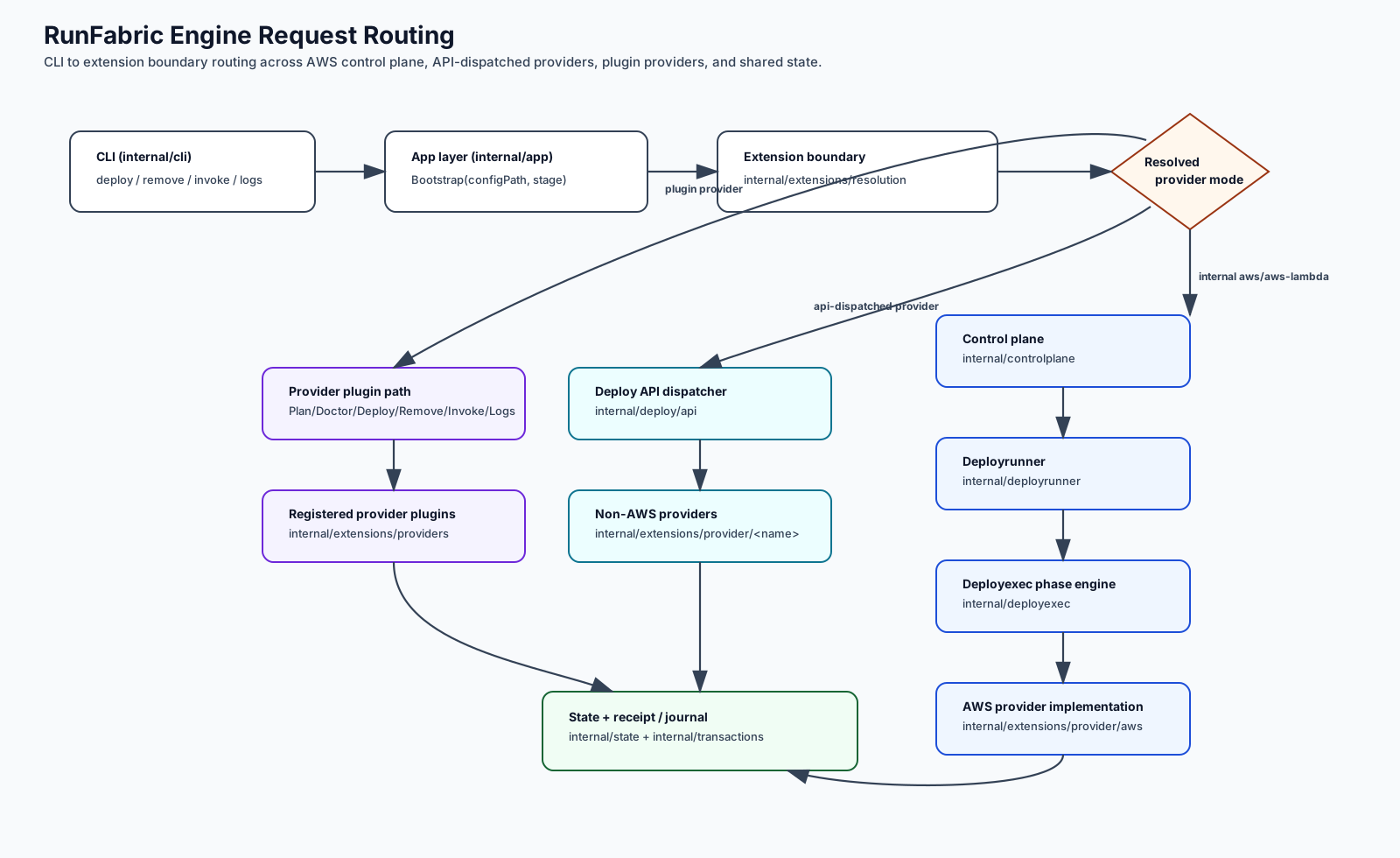
1. Entry: CLI commands
| CLI command | File | Calls app boundary |
|---|---|---|
runfabric deploy |
internal/cli/lifecycle/deploy.go |
platform/workflow/app.Deploy (or DeployFromSourceURL for --source) |
runfabric remove |
internal/cli/lifecycle/remove.go |
platform/workflow/app.Remove |
runfabric invoke run |
internal/cli/invocation/invoke.go |
platform/workflow/app.Invoke |
runfabric invoke logs |
internal/cli/invocation/logs.go |
platform/workflow/app.Logs |
internal/cli/common/app_service.go provides a small app-service interface used by CLI command handlers.
2. App layer: bootstrap and provider dispatch
Location: platform/workflow/app/
Core pieces:
bootstrap.goloads config, resolves extensions, and wires state backends.provider_dispatch.goresolves provider mode:dispatchInternaldispatchAPIdispatchPlugin
deploy.go,remove.go,invoke.go, andlogs.goroute behavior by mode.
3. Extension boundary and plugin resolution
Location: platform/extensions/registry/resolution/ and platform/extensions/providerpolicy/
- Resolution discovers built-in + external plugins and builds provider/runtime/simulator/router boundaries.
platform/extensions/providerpolicy/providers.gois the single platform importer of rootextensions/...plugin implementations.- Built-in precedence is preserved on ID conflicts unless explicitly overridden where supported.
4. Execution paths
- API-dispatched providers ->
platform/deploy/core/api(Run,Remove,Invoke,Logs). - Internal/plugin providers -> shared lifecycle contracts in
platform/workflow/lifecycle. - AWS controlplane path ->
platform/deploy/controlplaneorchestrates lock/journal/recovery behavior and usesplatform/deploy/execas the phase engine.
5. Recovery path
- CLI:
internal/cli/lifecycle/recover.go - App:
platform/workflow/app/recover.go - Shared recovery types/validation:
platform/workflow/recovery
Recover operations execute through provider recovery capability with durable journal state.
Workflow runtime flow: CLI -> app -> runtime -> step handler -> state
Workflow execution currently uses a single in-process durable runtime loop (not separate scheduler and dispatcher services).
Runtime path (as implemented)
- CLI command entrypoint (
runfabric workflow run|status|cancel|replay) ininternal/cli/common/workflow.go. - App boundary forwarding in
platform/workflow/app/workflow.go. - Durable runtime loop executes in
platform/deploy/controlplane/workflow_runtime.go. - Step execution dispatch (code/ai/human-approval) is handled by
platform/deploy/controlplane/workflow_typed_steps.go. - Durable run/step state persists through
platform/core/state/core/runs.gounder.runfabric/runs/<stage>/<runId>.json.
Scheduler vs dispatcher model (current decision)
- Keep scheduler and dispatcher as conceptual roles in docs for now.
- Implementation uses one
WorkflowRuntimeloop that performs both responsibilities:- selects the next executable step from durable run state,
- executes via
WorkflowStepHandler, - persists checkpoints/status transitions and retries,
- enforces pause/cancel/replay boundaries.
- No standalone scheduler/dispatcher services are implemented in the engine at this time.
Workflow binding layers
Two distinct binding layers exist and should not be conflated:
- Runtime step binding (engine runtime path)
- Binds workflow step kinds (
code,ai-*,human-approval) to typed handler behavior inworkflow_typed_steps.go. - MCP/tool/resource/prompt calls are runtime-level step concerns (policy + correlation metadata).
- Binds workflow step kinds (
- Provider orchestration binding (provider-native orchestration path)
- Binds configured provider extensions to cloud-native orchestrators (for example AWS Step Functions, GCP Cloud Workflows, Azure Durable Functions).
- This is provider extension/orchestration sync behavior, not the local
WorkflowRuntimestep scheduling loop.
AI workflow execution boundary
- AI step execution is centralized in
platform/deploy/controlplane/workflow_ai_runtime.gobehindAIStepRunner. TypedStepHandlerroutesai-retrieval,ai-generate,ai-structured, andai-evaltoAIRunner.- MCP tool/resource/prompt access is executed through
workflow_mcp_runtime.goand policy-checked in core runtime. - Provider adapters do not execute AI steps.
Contributor rule
Do not add AI execution logic to provider adapters. Keep AI execution in controlplane/runtime so behavior remains cloud-agnostic, testable, and policy-consistent.
Provider code layout
Built-in provider implementations live under extensions/providers/<name>/.
Structure
extensions/providers/
├── aws/
├── gcp/
├── azure/
├── cloudflare/
├── vercel/
├── netlify/
├── kubernetes/
├── alibaba/
├── digitalocean/
├── fly/
└── ibm/
Related built-in plugin roots:
extensions/runtimes/extensions/routers/extensions/simulators/extensions/secretmanagers/extensions/states/
API dispatch wiring remains provider-neutral in platform/deploy/core/api/ and provider policy mapping in platform/extensions/providerpolicy/.
Providers wired to deploy API
- alibaba-fc, azure-functions, cloudflare-workers, digitalocean-functions, fly-machines, gcp-functions, ibm-openwhisk, kubernetes, netlify, vercel
AWS uses the controlplane path.
See also: ARCHITECTURE_OWNERSHIP.md, DEPLOY_PROVIDERS.md, COMMAND_REFERENCE.md